

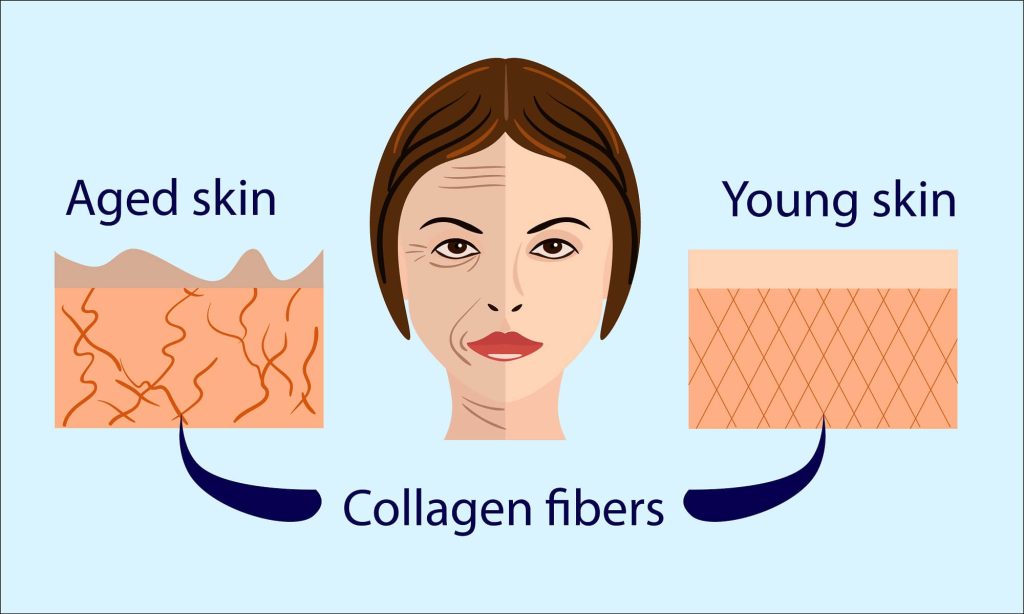
Collagen is a structural protein responsible for healthy joints and skin elasticity (stretchiness). It’s found in bones, muscles, skin, tendons, ligaments, blood vessels, and more—making up roughly three quarters of your skin and about one-third of the protein in your body. Biochemically, collagen is built from amino acids (especially glycine, proline, and hydroxyproline) arranged in long chains that twist into a triple-helix. This rope-like structure gives tissues their strength and resilience.
Think of collagen as the body’s internal scaffolding. It holds everything together, provides structure, and allows tissues to withstand movement, pressure, and stress. Without sufficient collagen, tissues begin to lose integrity, leading to visible and physical changes throughout the body.
The Main Types of Collagen
Researchers have identified at least 28 types of collagen. Five are most common:
- Type I: ~90% of the body’s collagen; found in skin, bone, tendons, ligaments.
- Type II: Concentrated in cartilage, supporting joint cushioning and flexibility.
- Type III: Present alongside Type I in organs and blood vessels, contributing to tissue architecture.
- Type IV: Located in specialized skin layers (basement membranes), important for filtration.
- Type V: Found in hair and cell surfaces; helps regulate how collagen fibers form.
Each type plays a slightly different role, but together they form a complex network that supports the body’s structure and communication systems.
What Collagen Does
- Structural support: Provides tensile strength and controlled elasticity in connective tissues.
- Tissue repair: Helps scaffold new tissue during healing.
- Cell communication: Participates in cell signaling, guiding repair and regeneration.
- Joint function: Maintains cartilage integrity and smooth movement.
Collagen is constantly being broken down and rebuilt. When this balance is disrupted, the body begins to show signs of decline.
Signs of Collagen Decline
As collagen production decreases, the body begins to show both visible and internal signs:
- Fine lines and wrinkles
- Joint stiffness or discomfort
- Reduced skin elasticity
- Slower recovery from injury
- Weaker hair and nails
- Increased susceptibility to inflammation
These changes are not just cosmetic—they reflect deeper shifts in tissue strength and repair capacity.
How the Body Makes (and Loses) Collagen
Collagen is produced by fibroblasts. Production naturally declines with age and is influenced by:
- Hormonal changes (especially menopause)
- Chronic stress
- Inflammation
- Poor nutrition
- Sleep disruption
- Environmental exposure (UV, toxins)
Over time, collagen breakdown can outpace production, leading to tissue weakening.
Diet & Nutrients That Support Collagen
Your body synthesizes collagen from dietary proteins. Key nutrients include:
- Vitamin C: Essential for collagen stability
- Zinc & Copper: Support collagen formation
- Protein: Provides amino acid building blocks
A simple strategy: combine protein with vitamin C in meals to support collagen synthesis.
Collagen & Joint Discomfort
Collagen plays a direct role in joint health. When levels decline:
- Cartilage becomes thinner
- Friction increases
- Movement becomes less smooth
This can contribute to stiffness, reduced mobility, and discomfort over time.
While supplements may support some individuals, results vary depending on overall lifestyle, stress levels, and internal regulation.
Where BioAcoustics May Fit
BioAcoustics offers a different perspective. Instead of focusing only on structural rebuilding (like nutrition), it looks at the regulatory systems that control repair.
Using voice analysis, we can identify stress patterns in the body that may interfere with collagen production, including:
- Nervous system overload
- Chronic stress signaling
- Hormonal imbalance
- Inflammatory patterns
How BioAcoustic Therapy Can Support Collagen Health
Collagen production is not just about nutrients—it depends heavily on the body being in a rest-and-repair state.
BioAcoustic therapy helps support this by:
- Calming the nervous system: Reducing stress allows repair processes to function properly
- Improving sleep quality: Deep sleep is when tissue repair and collagen synthesis are most active
- Supporting hormonal balance: Especially important during menopause when collagen decline accelerates
- Enhancing consistency: Structured listening routines help maintain daily health habits
Rather than forcing change, this approach helps the body return to a state where natural rebuilding can occur.
This is particularly relevant for people experiencing:
- Early aging signs
- Joint discomfort
- Hormonal shifts
- Chronic fatigue or slow recovery
A More Complete Approach
Collagen health is not just about what you take—it’s about how your body functions.
Supporting collagen requires a combination of:
- Nutrition
- Sleep
- Stress regulation
- Movement
- Internal balance
BioAcoustics fits into this by supporting the internal environment where all of these processes take place.